A new paper describing the results of a yeast evolution experiment has been published in Evolution. Jordan Gulli exposed nascent multicellular “snowflake yeast” to an environment in which solitary multicellular clusters experienced low survival. In response, snowflake yeast evolved to form cooperative groups composed of thousands of multicellular clusters.
Figure 2 from Gulli et al. 2019. Evolution of proteinaceous aggregates that bind many multicellular clusters. When subjected to strong settling selection, snowflake yeast evolved to form cooperative aggregates composed of hundreds of clusters (A). A composite image (B) reveals the aggregates are composed of both protein (C, green, Qubit fluorescent protein stain) and DNA (D, red, propidium iodide). Cells embedded within the aggregate are shown in blue (E, Cell Tracker Blue). Scale bars are 500 μm.
Coauthors currently at Georgia Tech in front of the Ramblin’ Wreck (left to right): Kimberly Chen, Will Ratcliff, Frank Rosenzweig, and me. Photo by Jennifer Pentz. Not shown: Josh Borin, Jacob Boswell, Jillian Walker, Alex Knox, and Maggie Boyd.
The time-lapse videos Josh Borin recorded, which show growth of unicellular and multicellular isolates described in the new Scientific Reports paper, are now available on YouTube. Although the videos for this open access paper are available for download from the publisher, several commenters have complained that they are not viewable on all platforms. Hopefully they are now viewable by everyone.
I have set this page up to link to science-related content from my personal blog, Fierce Roller. My reason for doing this is to make it easier to follow my science writing for people who are not interested in, for example, my disputes with creationists, skepticism about Cuban sound guns, and occasional political content.
I have set up a new page, Fierce Roller Blog, to post links to content from freethoughtblogs.com/fierceroller on topics related to my research interests. If I have set this up right, the blog content will not show up on my home page, which will be reserved for announcements related to my lab and research. You will find the blog content under the “Fierce Roller Blog” entry in the main menu.
In the post announcing the new paper in Scientific Reports, I accidentally linked to the DOI of the bioRxiv preprint instead of the peer-reviewed version of the article. The correct DOI is 10.1038/s41598-019-39558-8, and I have corrected this in the post.
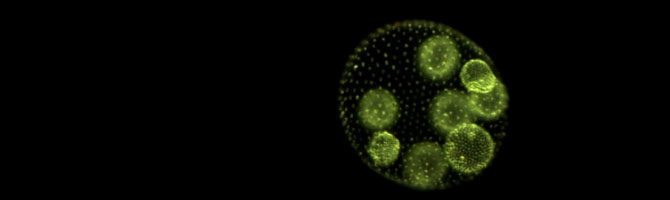
A new paper describing the results of a microbial evolution experiment has been published in Scientific Reports. Predation by the filter-feeding predator Paramecium tetraurelia drove the evolution of simple multicellular structures in the green alga Chlamydomonas reinhardtii:
Figure 2 from Herron et al. 2019. Depiction of C. reinhardtii life cycles following evolution with (B2, B5) or without (K1) predators for 50 weeks. Categories (A–D) show a variety of life cycle characteristics, from unicellular to various multicellular forms. Briefly, A shows the ancestral, wild-type life cycle; in B this is modified with cells embedded in an extracellular matrix; C is similar to B but forms much larger multicellular structures; while D shows a fully multicellular life cycle in which multicellular clusters release multicellular propagules. Representative microscopic images of each life cycle category are at the bottom (Depicted strain in boldface).
From the abstract:
Here we show that de novo origins of simple multicellularity can evolve in response to predation. We subjected outcrossed populations of the unicellular green alga Chlamydomonas reinhardtii to selection by the filter-feeding predator Paramecium tetraurelia. Two of five experimental populations evolved multicellular structures not observed in unselected control populations within ~750 asexual generations. Considerable variation exists in the evolved multicellular life cycles, with both cell number and propagule size varying among isolates. survival assays show that evolved multicellular traits provide effective protection against predation. These results support the hypothesis that selection imposed by predators may have played a role in some origins of multicellularity.
Herron MD, Borin JM, Boswell JC, Walker J, Knox CA, Boyd M, Rosenzweig F, Ratcliff WC. 2019 De novo origins of multicellularity in response to predation. Sci. Rep. 9, 2328. (doi: 10.1038/s41598-019-39558-8)
A new paper using analytical and simulation models to explore the relationships between particle-level heritability and collective-level heritability during major transitions has been published in BMC Biology:
Figure 3 from Herron et al. 2018. Relative heritability of four collective-level traits to cell-level heritability for size.