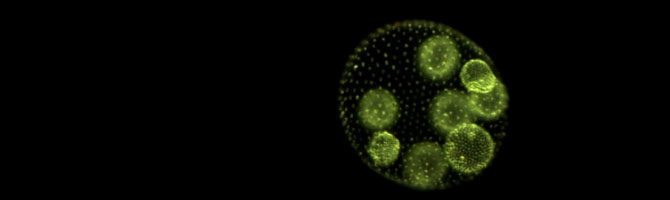
A new paper by former grad student Jacob Boswell, current grad student Ross Lindsey, Emily Cook, and Frank Rosenzweig is out in Biology Methods & Protocols (open access article):

Long-term preservation of laboratory strains of Chlamydomonas reinhardtii has historically involved either liquid nitrogen cryopreservation, which is expensive and labor intensive, or storage on agar plates, which requires frequent transfer to new plates, and which may leave samples susceptible to contamination as well as genetic drift and/or selection. The emergence of C. reinhardtii as a model organism for genetic analysis and experimental evolution has produced an increasing demand for an efficient method to cryopreserve C. reinhardtii populations. The GeneArt™ Cryopreservation Kit for Algae provides the first method for algal storage at −80°C; however, little is known about how this method affects recovery of different clones, much less polyclonal populations. Here, we compare postfreeze viability of clonal and genetically mixed samples frozen at −80°C using GeneArt™ or cryopreserved using liquid nitrogen. We find that the GeneArt™ protocol yields similar percent recoveries for some but not all clonal cultures, when compared to archiving via liquid N2. We also find that relative frequency of different strains recovered from genetically mixed populations can be significantly altered by cryopreservation. Thus, while cryopreservation using GeneArt™ is an effective means for archiving certain clonal populations, it is not universally so. Strain-specific differences in freeze–thaw tolerance complicate the storage of different clones, and may also bias the recovery of different genotypes from polyclonal populations.

Boswell, J., C. R. Lindsey, E. Cook, F. Rosenzweig, & M. D. Herron. 2021. Cryopreservation of clonal and polyclonal populations of Chlamydomonas reinhardtiiBiology Methods & Protocols 6:1-6. doi: 10.1093/biomethods/bpab011

Congratulations to Charles “Ross” Lindsey for successfully defending his Master’s thesis, “Phylotranscriptomics of the volvocine algae: A model clade for the study of differentiated multicellularity,” on Friday, January 15, 2021!

The final version of my essay on the Major Transitions in Evolution has been published in Biology & Philosophy: https://rdcu.be/cdph8If
Unfortunately, I didn’t have funding to make it open access; the ReadCube link above will allow reading but not downloading if you don’t have a subscription.
Herron M. D. 2021. What are the Major Transitions? Biology & Philosophy 36:2. Shareable link (free to read). Final, unformatted version available at PhilSci Archive.

EDIT April 1, 2020: updated link and slightly revised abstract to the new version

I have posted a new preprint to the PhilSci Archive:

The ‘Major Transitions in Evolution’ (MTE) framework has emerged as the dominant paradigm for understanding the origins of life’s hierarchical organization, but it has been criticized on the grounds that it lacks theoretical unity, that is, that the events that make up the category do not constitute a natural kind. I agree with this criticism, and I argue that the best response is to modify the category so that it does approximate a natural kind. Specifically, I recommend defining major transitions as all those, and only those, events and processes that result in the emergence of a new level of selection. Two sorts of changes will be required to achieve this. First, events and processes that do not meet this criterion, such as the origins of the genetic code and of human language, should be excluded. Second, events and processes that do meet the criterion, but which have generally been neglected, should be included. These changes would have the dual benefits of making MTEs a philosophically coherent category and of increasing the sample size on which we may infer trends and general principles that may apply to all MTEs.

Postdoc Kimberly Chen has published a lay summary of our recent Scientific Reports paper, in which we showed that predation can drive the evolution of multicellularity in the green alga Chlamydomonas:

Multicellular life is one of the most astonishing wonders on Earth, but why and how does it arise in the first place, and at what cost? To help answer these questions, we exposed single-celled algae to predators and watched them evolve into multicellular life. Within a year, they had formed groups of cells to avoid being eaten – but at a price.

Chen, I-C. K. & M. D. Herron. 2019. Predators drive the evolution of multicellularity. The Science Breaker 257. doi: 10.25250/thescbr.brk257

Herron et al. 2019 Fig. 2
Figure 2 from Herron et al. 2019. Depiction of Chlamydomonas reinhardtii life cycles following evolution with (B2, B5) or without (K1) predators for 50 weeks. Categories (A–D) show a variety of life cycle characteristics, from unicellular to various multicellular forms. Briefly, A shows the ancestral, wild-type life cycle; in B this is modified with cells embedded in an extracellular matrix; C is similar to B but forms much larger multicellular structures; while D shows a fully multicellular life cycle in which multicellular clusters release multicellular propagules. Evolved strains were qualitatively categorized based on growth during 72-hour time-lapse videos. Strains within each life cycle category are listed below illustrations. Representative microscopic images of each life cycle category are at the bottom (Depicted strain in boldface).

The Project Outcomes Report for our recently ended NSF grant (known variously as DEB-1723293, DEB-1457701, and DEB-1456652) is now available on grants.gov:

Life comes in two forms: single-celled (organisms made up of only one cell) and multi-celled (organisms made up of many cells, alike or different). Multicellular life has evolved from unicellular ancestors many times across the tree of life, and the resulting radiations have transformed nearly every ecosystem on Earth. Ancestors of animals, plants, fungi, several groups of seaweeds, and filamentous bacteria underwent the transition from single- to multi-celled life in the deep past. While each of these origins is a replicate experiment with the potential to inform our understanding of how and why multicellular life evolved, the window through which we see these ancient events is blurry. Extinctions, subsequent evolution, and a spotty fossil record obscure our view. Experimental evolution enables us to time-travel, making it possible to clearly observe the evolution of multicellularity as it occurs in the lab. This project integrated experimental, bioinformatic, theoretical, and comparative approaches to understand how multicellularity and related traits have evolved, and how they can evolve.

Continue reading